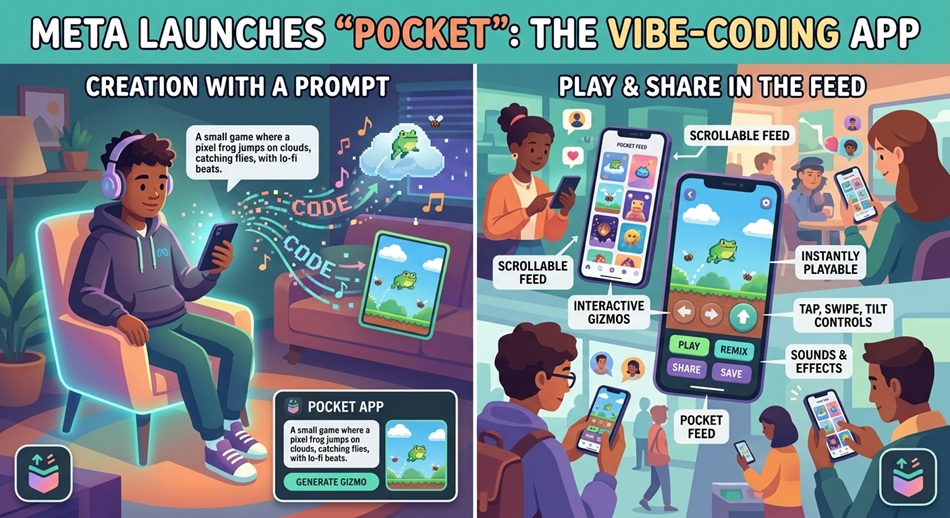
Meta has launched Pocket, an app that lets anyone describe a game idea in plain language and have AI turn it into a playable mini-game, to users across the US. The app had been quietly testing in Brazil before this wider rollout, and Meta is simultaneously shutting down Gizmo, the vibe-coded gaming platform it acquired the team behind earlier this year, folding its technology and purpose into Pocket instead.
“Vibe coding,” describing an app or game idea in natural language and letting AI generate the actual code, has mostly lived in developer-focused tools until now. Pocket is a bet that the same idea works for a much broader, non-technical audience if you wrap it in something that feels more like a social app than a programming tool.
What you can actually build with it
Inside Pocket, users describe an idea and let AI generate a playable version, which Meta calls a “gizmo.” From there, you can keep tweaking the result before sharing it with others. Gizmos can respond to taps, swipes, dragging, and phone movement, and some support music, sound effects, photos, and access to the camera or microphone. It’s positioned less as a coding tool and more as a creative platform for making small, shareable interactive experiences, closer to a mini-game maker than a development environment.
The Gizmo shutdown behind this launch
Pocket didn’t come out of nowhere. Meta acquired the team behind Gizmo, a vibe-coded gaming platform built by Atma Sciences, earlier this year, and Pocket is largely the product of folding that acquisition into Meta’s own app. Meta announced it’s shutting the original Gizmo app down as part of this transition, writing that “it’s bittersweet to shut down Gizmo, a labor of love by so many people for the last couple years.” That’s a familiar pattern for how Meta absorbs outside teams and technology: acquire, integrate, then retire the original product once its purpose has been folded into something with Meta’s own branding and distribution behind it.
Where this fits in Meta’s bigger AI-creation push
Pocket is the latest in a string of Meta products built around the same core idea: let AI handle the technical execution while a person just describes what they want. The company has already pushed AI-generated images through its Meta AI app and AI-generated video through an experimental app called Vibes. Pocket applies that same pattern to interactive games and apps specifically, which is a meaningfully harder technical problem than generating a static image or video clip, since a playable gizmo actually has to respond correctly to input in real time.
Bottom line
Meta is betting that vibe coding isn’t just a tool for developers experimenting with AI, but something ordinary people will want to do for fun if it’s packaged the right way. Pocket’s real test isn’t whether the AI can generate a working mini-game; it’s whether enough non-technical people actually want to make and share one.