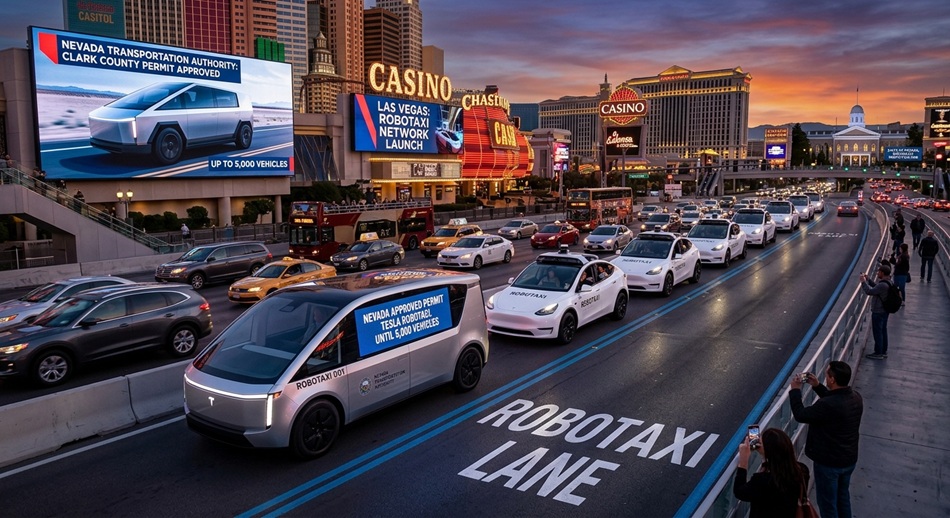
The Nevada Transportation Authority has unanimously approved permits allowing Tesla, Uber, and Waymo to run commercial robotaxi services in Clark County, with Tesla’s permit covering up to 5,000 vehicles. Combined, the three companies’ permits allow for up to 8,000 robotaxis across the county over the next 12 months, though none of them are expected to actually deploy anywhere near that many vehicles in year one.
This is a reversal from just a few days earlier, when regulators had capped Tesla’s Las Vegas robotaxi fleet at a token 10 vehicles despite the company applying for permission to run 5,000. That initial approval came with tight restrictions too: a 45mph speed limit, confinement to the Strip corridor, and an explicit ban on airport pickups. The new approval opens the door to something much closer to what Tesla originally asked for.
What actually changed
Nevada regulators moved from a narrow, closely supervised pilot permit to a much broader commercial authorization in a short window of time. The earlier 10-vehicle cap looked like regulators testing the waters before committing to anything larger; the new permit suggests that early period gave them enough confidence to expand quickly, rather than requiring a long, drawn-out phase-in.
Company representatives have indicated that the real number of vehicles on the road in the first year will land well below the maximum permitted figures. Permits define a ceiling, not a rollout plan, so 8,000 robotaxis is the legal limit for the county over the next year, not a number anyone should expect to actually see on the Strip anytime soon.
Why Tesla, Uber, and Waymo all got approved together
Bundling three companies’ permits into one regulatory action signals Nevada is trying to establish a general framework for commercial robotaxi operations in Clark County, rather than negotiating one-off deals with individual companies. Waymo already has real-world robotaxi experience in other markets, Uber brings an existing ride-hailing platform and user base to plug autonomous vehicles into, and Tesla brings by far the most aggressive expansion ambitions of the three. Approving all three under similar terms suggests a policy decision to open the market broadly rather than pick a single winner.
What to actually watch next
The permit ceiling is the easy part; the real story over the next year is how quickly each company actually scales toward it, and whether the safety restrictions loosen further (or tighten back up) once real ridership numbers come in. Las Vegas has effectively become one of the most closely watched robotaxi markets in the country almost overnight, and how this rollout goes will shape how other states approach similar permits.
Bottom line
Nevada didn’t just approve a Tesla pilot program; it opened the door for three major players to run commercial robotaxi services in Las Vegas at meaningful scale. The permitted ceiling is high, the actual rollout will almost certainly be much slower, and how it plays out will likely influence robotaxi regulation well beyond Nevada.