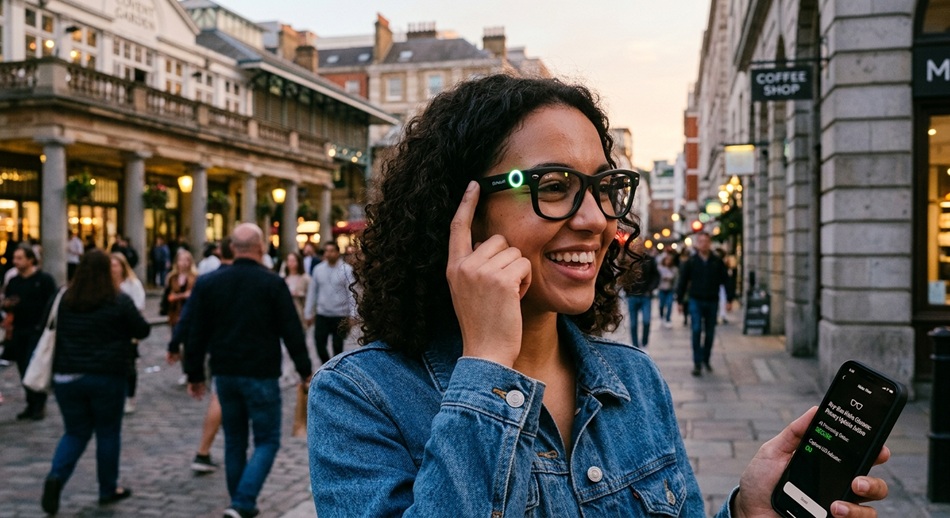
Meta is launching a software update for its Ray-Ban and Meta smart glasses which turns off the camera whenever someone covers the small recording light while a video is already in progress. This update fills the gap left by a previous fix from July, which had prevented a recording from starting when the light was blocked but did nothing once the camera had already begun.
What the update does
Next to the camera on Meta’s glasses there is a white LED which flashes each time the device is taking a photograph or recording a video. This is the only indication given to people who are nearby, since the glasses produce no shutter sound. Meta believes that it is not practical to have an audible signal on an item which people wear on their face daily.
The updated version includes tamper detection when a recording is in progress; if the glasses detect that the capture light has been covered, blocked or physically damaged during the recording, the camera will stop. Alex Himel, Meta’s vice president of augmented reality, stated that the camera will now stop functioning if the light is covered while a recording is taking place, and remarked that “the fact that they have to go to these lengths shows our efforts are working”. Meta says that the change is now beginning to be rolled out, although it does not provide a specific date, and it applies to the current Ray-Ban Meta glasses as well as to the broader Meta smart glasses range.
The loophole it closes
Meta had previously attempted to restrict this feature. In a July update to the second-generation Ray-Ban Meta glasses, the camera was disabled if the LED was covered or desoldered before recording started. The issue was to do with timing; a user could begin recording normally with the light on and then put a piece of tape over the LED. The original check only took place at the start, which meant that the camera continued to film with no visible sign. The new version, however, continuously checks while the camera is in use.
A small industry in disabling the light
The update also addresses the situation in which people are selling the workaround. 404 Media kept records of a mail-in service worth about $60 which was operated by a hobbyist, Bong Kim, the purpose of which was to permanently remove the recording LED by desoldering it, thus leaving the camera fully functional and silent. Meta states that it has removed thousands of ads and marketplace listings for services involving LED tampering and plans to take legal action against those who are offering such services.
Why the indicator is still contested
Privacy researchers have for many years maintained that the light carries out very little function. Most people don’t know what a small blinking LED on a pair of glasses signifies. Visibility outdoors in daylight is difficult, and the light is only of any use if it is switched on and not blocked, which is precisely what these workarounds aim at. Moreover, a lawsuit brought against Meta claims that contractors in Kenya looked at the footage from the glasses, including private moments, as they were training the company’s AI models.
The always-on glasses question
The fact that the timing is important is due to the fact that Meta is testing prototype glasses which record in a more aggressive manner. The Financial Times has reported on a “super-sensing” project which captures audio continuously and takes a photo every few seconds so that the wearer can later ask Meta’s AI what it has seen or heard.
It is said that executives considered the idea of not switching on the capture LED at all in those modes. Meta states that the unprocessed footage from that prototype will neither be stored by the company nor made available to users, and that the plans might still change. At present it is a research device and not a product.
What owners should know
If you have a pair, the update will be installed via the Meta AI app just as firmware updates have always been installed, with no need to turn anything on. As previously, the recording light acts in the normal way when in use. The only real difference is that if you deliberately block the light it will stop the recording rather than just hide it. When you are near someone who is wearing these glasses, the same advice as always applies: a blinking white light near the lens indicates that the camera is on, and it is now a bit more difficult to make that light appear false.
Bottom line
Meta has put an end to the most obvious method of recording people without the warning light appearing. While this does not address the broader concern that a small LED amounts to a weak form of consent, it also says nothing about the prototype glasses designed to detect everything in the wearer’s surroundings. This is merely a remedy for the present product and a very limited one.