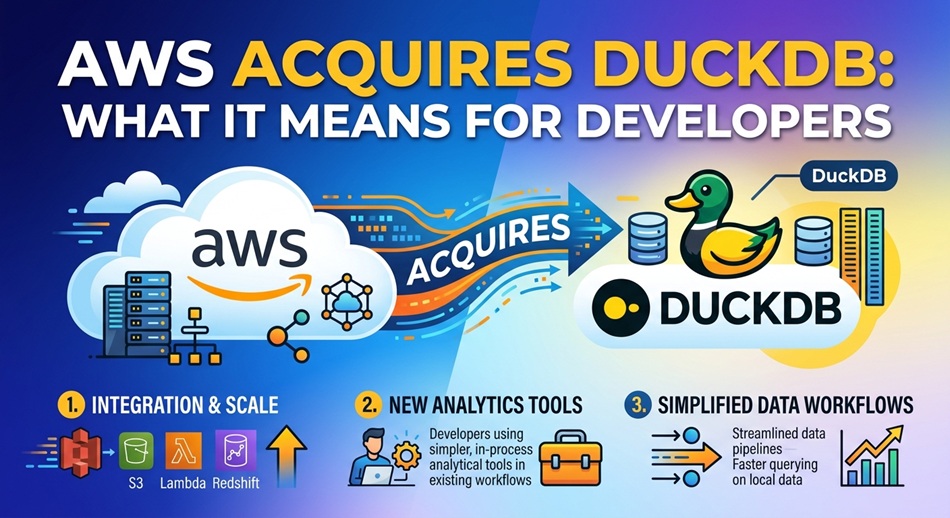
AWS has reached an agreement to buy DuckLabs, the company based in Amsterdam which developed DuckDB, the open-source analytics database that has in recent years become one of the most discussed tools in the field of data engineering. Although the deal has no direct impact on DuckDB’s open-source licence or its governance, it is currently the leading story on Hacker News, with developers discussing the implications for a project of such popularity to end up being owned by the world’s largest cloud provider.
What AWS actually bought
The difference is important in this case: it was the commercial company DuckLabs, not DuckDB itself, that was acquired by AWS, the company having been co-founded by Hannes Muhleisen and Mark Raasveldt, the creators of DuckDB. The open-source project will continue to be run by the independent, non-profit DuckDB Foundation and will remain under the MIT licence.
Muhleisen and Raasveldt are joining Amazon and will retain responsibility for guiding the project’s technical development once the agreement is completed. Amazon has not revealed how much it paid, and the announcement presents the two companies as having been working together since 2024, prior to this acquisition taking place.
For anyone who is using DuckDB at the moment, the practical conclusion is that nothing has changed yet: it’s still free, still covered by the MIT licence, and still works in the same way whether it’s in a Python notebook or used within an application. Any changes, which may or may not take place, will appear after months or years, not this week.
Why DuckDB became worth buying
DuckDB is generally referred to as an “in-process” or embedded analytics database; rather than setting up a server and then connecting to it, you can simply incorporate DuckDB directly into a Python script, a notebook, or an application and execute fast analytical (OLAP) queries on local files, Parquet, CSV, or data stored in S3, without the need to start up a cluster.
It is precisely this simplicity that has caused it to become so popular among data scientists and engineers who had become fed up with having to provision Spark jobs for tasks that could be carried out on a laptop.
For AWS this approach fits well with its strategy of making analytics on S3 faster and cheaper without customers having to set up a full data warehouse. Andy Warfield, who is a vice president and distinguished engineer at AWS, said that the DuckDB team had spent almost a decade creating “a tool that lets people work with data, with confidence,” a statement which shows that AWS wants the DuckDB team’s engineering expertise and product mindset to be incorporated into its own analytics stack, not just the codebase.
Why developers are nervous
The Hacker News thread for this story reached 700 points and more than 190 comments within a short time, and the general attitude is one of caution rather than celebration. The comparisons people are making are not pleasant: there’s the case of MySQL going silent after Oracle acquired it, Redis altering its licence and thereby forcing AWS to fork a replacement called Valkey, and Elastic doing the same thing with Elasticsearch.
The concern among developers is that the momentum of a popular open-source project will slow down, or that its course will shift in favour of the acquirer’s cloud business, once the people who had the power to say no to that have been absorbed into a much larger organisation.
Another specific loser in the story is MotherDuck, the venture-backed startup which created a managed cloud platform based on DuckDB. Many of the commenters were clear about the position MotherDuck is now in, that is, competing with the same infrastructure it relies on, when its competitor has unlimited AWS distribution behind it.
It isn’t true that everyone is pessimistic. There is in fact a counter-argument within the same thread which states that combining MIT licensing with an independent foundation does provide a real structural safeguard, not merely a rhetorical claim.
Should AWS mishandle the project, the community could always fork it, and there are already available alternatives such as Apache DataFusion and Polars which act as pressure valves. The technical lead of DuckDB wasn’t chosen because the project was owned by a particular company, and that expertise will not vanish simply because different people sign the paycheques.
Bottom line
The way you currently use DuckDB won’t change, and because of its open-source licence and the way the project is structured, it enjoys a higher level of protection than most projects that have been acquired. However, the skepticism seen on Hacker News isn’t paranoia; it’s simply pattern-matching based on a decade’s worth of experience with open-source tools losing their edge after being taken over by a hyperscaler. Whether or not DuckDB escapes that fate will depend less on the details of the deal than on what AWS actually plans to do with the team over the coming years, and on whether the company treats DuckDB as a product to protect or as a feature to incorporate into S3.