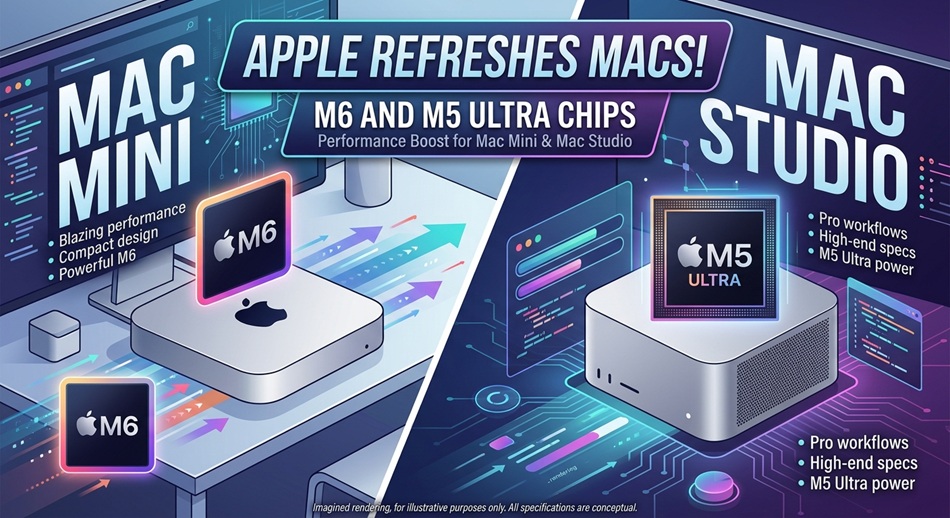
Today, Apple made a quiet update to its Mac mini and Mac Studio ranges without holding a keynote or giving any prior notice, launching the M6, its first chip manufactured using a 2-nanometer process, together with a new M5 Ultra for the high-end Mac Studio. The Mac mini is now priced at $899 when equipped with the M6 or at $1,699 if the M5 Pro is chosen, while the Mac Studio starts at $2,499 with the M5 Max or at $5,499 with the M5 Ultra. Pre-orders for both models are now open and delivery will begin on September 22 alongside macOS 27.
The M6 adds a chip tier Apple has never shipped before
The Mac mini’s base model features a 12-core M6 chip, which has two additional cores compared to the M4 or M5, although the more significant change is architectural: the M6 is the first Apple silicon chip to employ three different kinds of CPU cores rather than two, comprising 2 “super cores” in addition to the standard 4 performance cores and 6 efficiency cores.
Apple states that this combination achieves the fastest single-threaded performance of any chip it has ever released, offering up to 1.2 times faster multithreaded performance than the M5 and 2.4 times faster performance than the original M1.
For the first time on a base Mac mini, each core of the 12-core GPU includes a Neural Accelerator, a feature Apple says has increased peak AI computing power by 30% compared to the M5 and more than eight times that of the M1.
According to Apple’s own figures, the new Mac mini is up to four times faster for AI workloads and twice as fast for gaming than the previous M4 model. The base version is equipped with up to 32GB of unified memory operating at a bandwidth of 170GB/s, along with Thunderbolt 4, Wi-Fi 7, and 2.5Gbps Ethernet.
If you choose the M5 Pro version, the Mac mini is equipped with as much as an 18-core CPU, a 20-core GPU, 64GB of unified memory running at 307GB/s, and Thunderbolt 5, at a price of $1,699.
Mac Studio gets Apple’s first quad-die chip
The bigger design story is in the Mac Studio. The entry-level model with the M5 Max has held its price at $2,499 from the previous generation, but the standout feature is the M5 Ultra: Apple’s first quad-die chip, produced by joining two M5 Max dies together using UltraFusion and offering an interconnect bandwidth of 4.4TB/s. This version provides up to 36 CPU cores (including 12 super cores) and up to 80 GPU cores, as well as PCIe Gen 6 storage that doubles the speed of the previous generation.
Apple states that the M5 Ultra is up to 25% faster than the M3 Ultra in single-threaded tasks, 30% faster in multithreaded tasks, 4.5 times faster for AI computations, and 40% faster for graphics. It’s also capable of driving four Apple Studio Display XDR monitors at the same time at 5K and 120Hz, which makes clear this chip is meant as a workstation part for studios and AI developers, not a general creative upgrade.
Storage and pricing didn’t move in buyers’ favor
The price of the M6 Mac mini increased by $100 compared to the previous generation, while storage remained limited to 256GB, a capacity that fills up quickly for people running local AI models, precisely the group Apple is targeting with the Neural Accelerator upgrade. Although the entry-level price of the Mac Studio stayed the same, the $5,499 M5 Ultra model is priced beyond what most individual buyers would consider, which shows Apple designed this particular configuration for studios and AI infrastructure rather than as a mainstream desktop upgrade.
Why it matters
The real story here goes beyond the spec sheet, since this is Apple’s first chip shipped on the 2-nanometer process node, and the three-tier core design (super, performance, and efficiency cores together) represents a new architecture rather than just an increase in clock speed for the existing M-series design. Pairing that debut with a quad-die M5 Ultra built for local AI workloads shows where Apple believes the growth will come from: not more people buying a Mac Studio to edit video, but more buying one to run large models locally without paying for cloud inference. The fact that there was no keynote or event to announce it suggests Apple is treating this as a routine part of its lineup refresh rather than a major flagship moment, even though the chip’s underlying architecture is genuinely a first.
Bottom line
If you’re upgrading from an M1 or M2 Mac mini, the jump in both raw performance and AI computing power is significant enough that you’ll notice it right away. If you’re choosing between the M6 and the M5 Pro Mac mini, the additional $800 mainly buys more memory bandwidth and Thunderbolt 5, which makes sense for professional workloads but is probably not worth it for normal day-to-day use. And if your goal is large-scale local AI inference, the M5 Ultra Mac Studio is the first Apple silicon chip designed specifically for that purpose, at a price that reflects it.