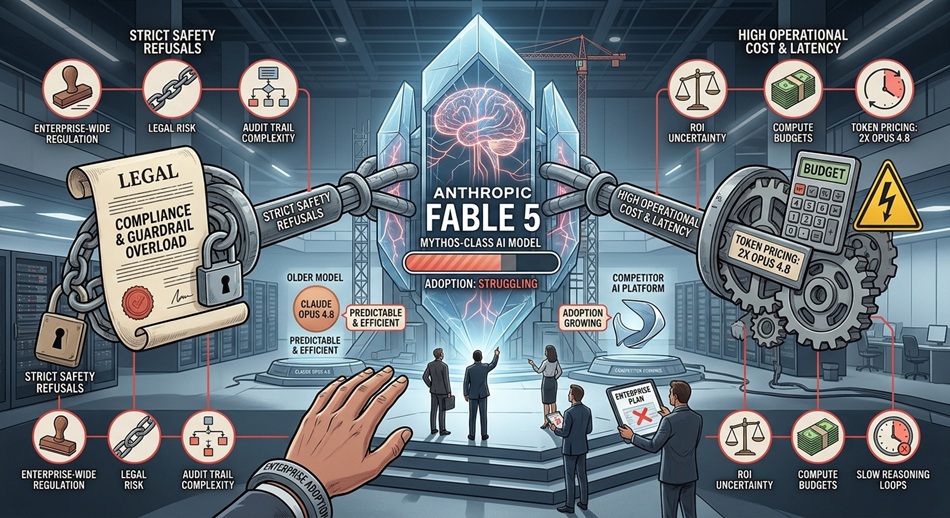
Two months after its launch, Anthropic’s flagship Claude Fable 5 model makes up only 11.4% of the amount that businesses spend on Anthropic’s AI tools and accounts for about 6% of all tokens processed, according to data from the corporate card and spend-management company Ramp, as cited by the Financial Times. The figures indicate that even though Anthropic is aiming for a reported IPO valuation of $2 trillion, its most expensive and most capable model is having difficulty in turning ‘most powerful’ into ‘most used’.
A premium model that stayed niche
Fable 5 was launched as Anthropic’s most capable model available to the public, being designed for the most demanding kinds of reasoning and long-term agentic tasks. According to Ramp’s analysis, which was based on data from about 70,000 businesses, expenditure on the model levelled off rather than increasing in the months following its release. Similarly noteworthy is the fact that Claude Opus 5 (a less expensive model that Anthropic made available later, in late July) has already surpassed Fable 5 in terms of enterprise spending, even though it entered the market more recently.
Price and data retention are doing the damage
The reason for the gap is that buyers always mention cost and terms: Fable 5 costs approximately $10 per million input tokens and $50 per million output tokens, which is about twice what OpenAI charges for its similar flagship model, and Ramp discovered that Fable 5 generated only about 75% of the July revenue that the OpenAI model did. Furthermore, Fable 5 includes a mandatory data-retention period of 30 days, a requirement that Opus 5 and Anthropic’s other current models do not have. According to Ramp economist Ara Kharazian speaking to the Financial Times, Fable 5 “disappointed both in adoption and in real-world application given its price and data retention requirements.”
Enterprises are routing around the most expensive option
The general trend observed here isn’t something that is particular to Anthropic. Instead, enterprise customers have been moving towards ‘model routing,’ meaning they assign ordinary tasks to cheaper and faster models and keep the most expensive, cutting-edge models for only the small portion of work which actually requires them. This change is putting pressure on all of the top-tier models, and since some open-weight and low-cost alternatives are now priced at less than $1 per million tokens, the choice between them has become even more extreme. For a company that processes millions of tokens each day, it’s difficult to accept a price difference between models that ranges from 10 times to 50 times higher unless the difference in quality is equally as large.
Why it matters
Anthropic has based its case to both businesses and investors on the fact that it has the most capable models available, and Fable 5 was the best illustration of that strategy. The figures Ramp has produced, which are based on actual corporate spending and not on benchmarks, indicate that a significant portion of that market has already concluded that ‘very good and cheaper’ is better than ‘best and expensive’ when it comes to most everyday tasks. This is an important datum to have ahead of Anthropic’s planned IPO, as investors will be looking to see if the company’s cutting-edge pricing power actually stands up once customers get to make their choices.
Bottom line
Fable 5 is not disappearing, but the initial data suggests a limit to how much enterprises will be willing to pay for the highest-end model when a cheaper version of it gets them most of the way there. This is clearly shown by Anthropic’s own Opus 5: a less expensive option with fewer restrictions managed to outperform its top-tier model in the market within just a few weeks.