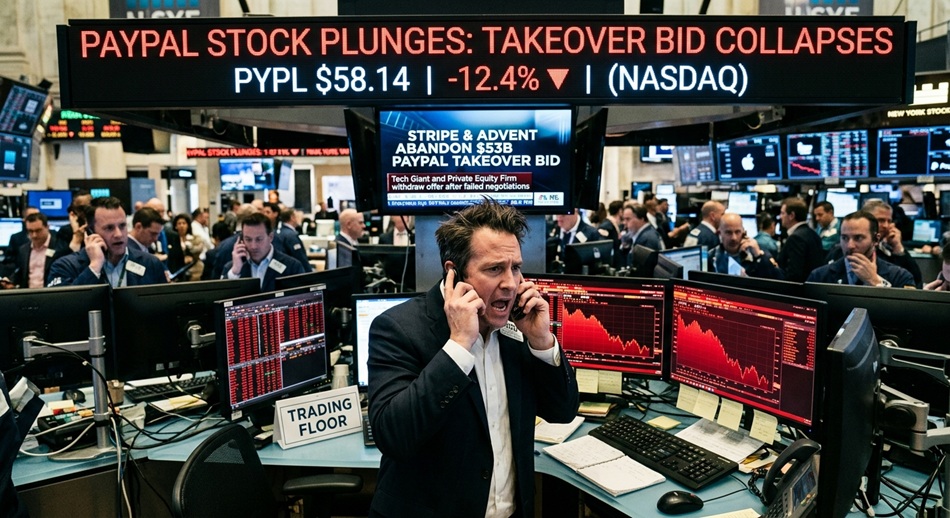
On Friday, August 28, PayPal’s shares dropped following reports by Bloomberg and Reuters that the private equity firm Advent International and the payments company Stripe had withdrawn from a bid worth about $53 billion to take the fintech pioneer private. The stock declined by as much as 15 per cent during early trading and thus lost most of the ground it had gained since takeover interest was first noticed in July.
What happened
For months the consortium had been looking at PayPal. Reuters stated that the two companies were in communication in July, at a time when PayPal was trading close to the levels it had reached over the previous years and had a market value of about $40 billion. It had been reported earlier in the year that Stripe, which is still a privately held company, had considered making an offer. Discussions went on throughout the summer, but by the end of August the buyers had decided not to move forward. Commentaries were declined by representatives from Advent, Stripe and PayPal.
The offer that got away
The reports stated that the group had offered $60.50 per share, thus putting the value of PayPal at over $53 billion. That seemed generous in July, but by the end of August it looked a great deal less so. Following the announcement, PayPal’s share price had risen by nearly 30 per cent, due to the company’s second quarter earnings report beating Wall Street’s expectations. By the time the deal collapsed, the stock price was already close to the offer price, leaving the buyers with very little room to pay shareholders a premium.
Why the deal collapsed
There were two factors that opposed the deal. The first of these was the price. PayPal’s board had previously regarded the initial bid as insufficient, and Bernstein’s analysts stated that management would not consider any offer that did not exceed $70 per share. The second factor was the enormous scale of the transaction. A leveraged buyout totaling $53 billion or more would have been one of the largest ever attempted, and the more PayPal’s share price rose, the harder it became to finance.
Moreover, the U.S. and European regulators would have closely examined the situation in which Stripe, a major payments processor, absorbed one of its biggest rivals. Troy Hooper from Mergermarket described the decision by saying that the buyers had reached the conclusion that “the juice wasn’t worth the squeeze”.
What it means for PayPal
PayPal is now on its own once more, and the market responded directly. Since there has been no offer made to support the stock, it is trading at a substantial discount to its rivals, the figure being about 11 times forward earnings compared with an industry average of around 15. The pressure is now on Enrique Lores, who became CEO of PayPal in March after the board had dismissed Alex Chriss.
The company Lores took over has seen its branded checkout service, the PayPal button which appears in online stores, being gradually overtaken by Apple Pay, Shop Pay and the like. The beat on earnings in July gave him a certain amount of credibility. Simply maintaining the stock at its present level without any takeover premium will require more than just one strong quarter.
What Stripe does next
Stripe has now moved beyond that. The company has recently reached an agreement to purchase OpenRouter, a marketplace that allows users to switch between different AI models, which shows that its goals are now focused on AI infrastructure rather than on making a costly acquisition in the area of consumer payments. Bloomberg pointed out that the buyers from PayPal might come back if the share price drops again and the figures once more make sense, but at the moment there is no active process underway.
Why it matters
It was the largest deal ever in the payments industry and it didn’t occur because the target company became more expensive while the buyers held on to their positions. The message for PayPal’s shareholders is that the business must be worth having on its own merits. For the broader fintech sector, the collapse indicates that even valuations which have been greatly reduced are not always cheap enough to lead to a massive buyout when interest rates, financing conditions and antitrust oversight are all working against such a move.
Bottom line
Advent and Stripe have decided to suspend their pursuit of PayPal at this stage. The stock has already returned the takeover premium and is now trading at about $54. Its ability to recover will depend on Enrique Lores demonstrating that the turnaround is genuine, not on the basis of a rescue deal.