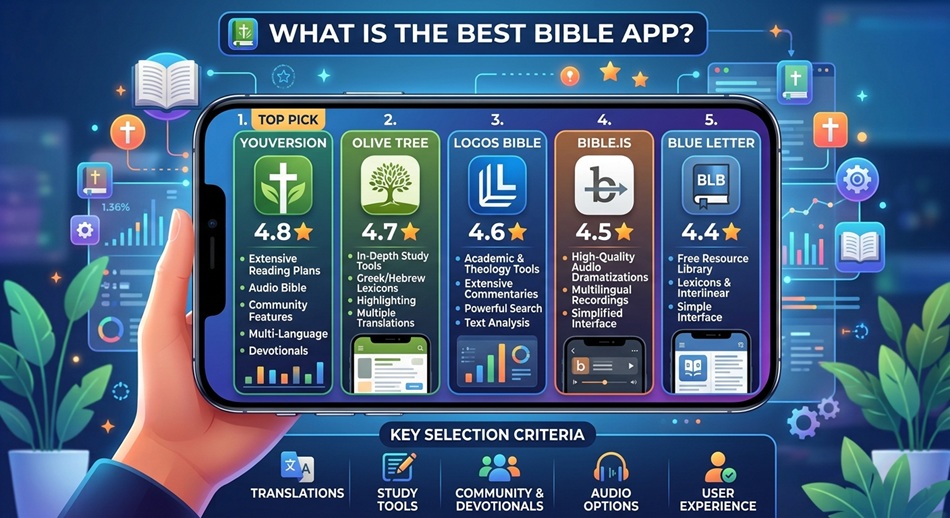
YouVersion (the Bible App) is the best Bible app for most people, since it’s completely free, includes hundreds of translations and languages, and its reading plans and collaborative features make it the easiest way to actually build a consistent reading habit with others. If your priority is serious original-language study instead, Blue Letter Bible is the stronger choice.
Bible apps split into a few genuinely different categories: apps built for daily reading habits, apps built for deep study, and apps built around a specific tradition or use case. The “best” one depends entirely on which of those you actually need.
YouVersion: best for daily reading and reading plans
YouVersion’s core strength is making a reading habit easy to stick to: structured reading plans, verse-of-the-day notifications, and the ability to follow along with friends or a group, which adds real accountability that reading alone doesn’t. It’s free, covers an enormous range of translations and languages, and is the most widely used Bible app for exactly these reasons.
Blue Letter Bible: best for original-language study
Blue Letter Bible is built for people who want to go deeper than a translation: it includes tools for examining the underlying Hebrew and Greek text, direct links to Strong’s Concordance, interlinear Bibles, and side-by-side translation comparison. It’s a genuinely different tool than YouVersion, aimed at study rather than daily devotional reading.
Bible Gateway: best for comparing translations side by side
Bible Gateway’s core feature is letting you view multiple translations of the same passage at once without switching tabs or apps, which is useful specifically when you’re trying to understand how a passage is worded differently across versions.
Olive Tree: best for customizable study resources
Olive Tree lets you build out a study setup with commentaries, dictionaries, and other resources tailored to how you actually study, rather than a fixed set of tools. It’s a strong pick if you want a study app you can genuinely customize over time.
Dwell: best for audio Bible listening
Dwell is built specifically around immersive audio scripture, multiple narrators, ambient background options, and a listening-first experience, for people who absorb scripture better by ear than by reading.
Ascension: best for Catholic users
Ascension bundles the Great Adventure Catholic Bible, the full Catechism of the Catholic Church, and Fr. Mike Schmitz’s Bible in a Year podcast into one free app, making it the most complete option built specifically around Catholic tradition and resources.
Glorify: best for a devotional habit beyond just reading
Glorify combines guided prayer, worship music, and scripture reading into one daily devotional flow, rather than treating the Bible text as the only thing the app does. If your goal is a broader daily spiritual habit, not just reading a chapter, this is built around that specifically, and it’s free.
Logos Bible Study: best for pastors and serious academic study
Logos is built for a different audience than everything else on this list: seminary-level study with an enormous library of commentaries, original-language resources, and cross-referencing tools, aimed at pastors and scholars rather than everyday devotional reading. It’s powerful, and priced accordingly, with core functionality free and serious depth behind paid resource packs.
Bible App for Kids: best for teaching children
Bible App for Kids (also from Life.Church, the team behind YouVersion) turns Bible stories into an interactive, narrated, kid-friendly experience rather than presenting text a child would struggle to engage with. It’s free and built specifically for a young audience rather than being a stripped-down version of an adult app.
BibleProject: best for understanding themes and context, not just verses
BibleProject is built around explaining the bigger picture, themes, literary structure, and how books of the Bible connect, through video content and reading plans rather than a traditional verse-lookup tool. It’s a strong complement to any of the apps above if your goal is understanding context, not just reading text.
Which one should you actually use?
- Want to build a daily reading habit: YouVersion.
- Studying the original Hebrew or Greek text: Blue Letter Bible.
- Comparing translations side by side: Bible Gateway.
- Want a fully customizable study setup: Olive Tree.
- Prefer listening over reading: Dwell.
- Looking for Catholic-specific resources: Ascension.
- Pastor or seminary-level study: Logos Bible Study.
- Teaching a child: Bible App for Kids.
- Want to understand themes and context, not just verses: BibleProject.
Frequently asked questions
What is the most popular Bible app?
YouVersion (the Bible App by Life.Church) is by far the most widely used, largely because it’s free, covers an enormous number of translations and languages, and is built around reading plans that make daily use easy to stick with.
Is there a Bible app with real Hebrew and Greek study tools?
Blue Letter Bible is specifically built for this, with interlinear Bibles, Strong’s Concordance links, and lexicon entries for examining the original language behind a translation.
Can I use a Bible app without an internet connection?
Most major Bible apps, including YouVersion, let you download specific translations and reading plans for offline use, though initial setup and some features do require a connection.
Are Bible apps free, or do they charge for full access?
Most of the apps here, including YouVersion, Bible Gateway, and Blue Letter Bible, are free to use. Some study-focused apps like Olive Tree sell additional commentary and resource packs as optional add-ons.