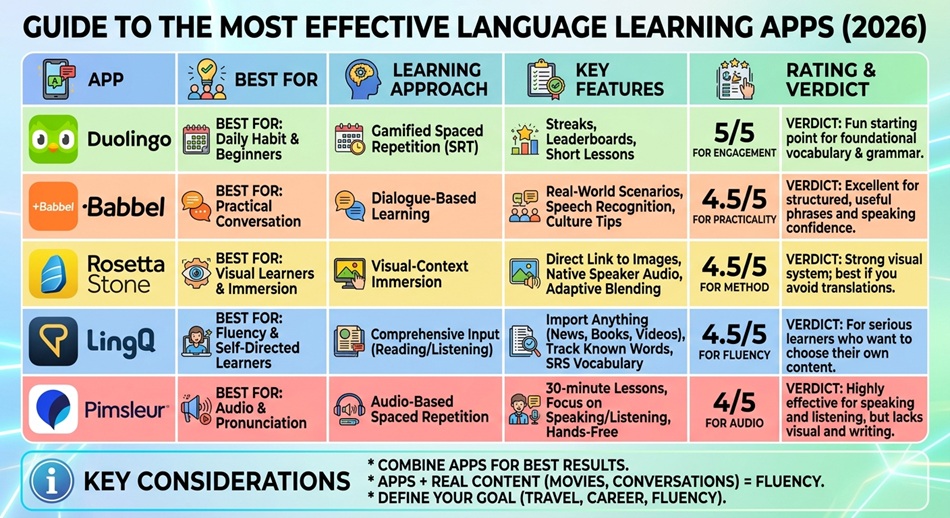
Duolingo is the best language learning app overall for most beginners, since its gamified, bite-sized lessons build a daily habit better than almost anything else and it covers both Spanish and Japanese. But it’s not the best choice for every language: for Spanish specifically, Babbel’s structured conversation-first approach gets you speaking faster, and for Japanese specifically, LingoDeer’s grammar explanations and proper kana progression beat Duolingo once you’re past the absolute basics.
The mistake most people make is picking one app and assuming it’ll carry them all the way to fluency. It won’t, and that’s true of every app on this list. The honest way to use these tools is to pick the one that matches your actual goal (building a habit, learning conversational Spanish, or getting through Japanese’s three writing systems) and swap or add a second app once you outgrow it.
Duolingo: best for building a daily habit, any language
Duolingo’s streaks, leaderboards, and 5-minute lessons are specifically designed to get you opening the app every day, which matters more for actually learning a language than any single feature does. It covers more than 40 languages including both Spanish and Japanese, and for a complete beginner in Japanese specifically, its structured progression through hiragana and katakana is a genuinely solid on-ramp.
Limitation: Duolingo alone won’t get you conversationally fluent. It’s strong on vocabulary and pattern recognition, weaker on real speaking practice and grammar depth, especially once you’re past beginner level.
Best app to learn Spanish: Babbel
Babbel is built around practical, conversation-first lessons instead of gamified drills, which makes it the stronger pick specifically for Spanish if your goal is actually talking to people, not just recognizing words. Its grammar explanations are clearer and more thorough than Duolingo’s, and lessons are built around real-life scenarios like ordering food or asking for directions.
Limitation: Babbel is a paid subscription with no meaningful free tier, and it doesn’t have Duolingo’s habit-building gamification, so it’s easier to fall off if you’re not self-motivated.
Best app to learn Japanese: LingoDeer
LingoDeer was built specifically for Asian languages, and it shows: lessons start with hiragana and katakana, move into grammar with actual explanations (not just “this is correct” pattern matching), and each lesson combines reading, writing, listening, and speaking practice. For a language as structurally different from English as Japanese, that grammar-first approach matters a lot more than it does for Spanish.
Limitation: LingoDeer has a smaller content library than Duolingo and a much smaller user community, so you won’t find the same social/leaderboard motivation.
WaniKani: worth adding once you’re serious about Japanese kanji
Kanji is the part of Japanese that breaks most learners, and WaniKani is built around a spaced-repetition system specifically for memorizing kanji and vocabulary long-term, rather than just recognizing them in the moment. It’s a specialist tool, not a full course, and it’s best used alongside LingoDeer or a similar app once you’ve got the basics down.
Migaku: for immersion once you have a foundation
Migaku turns real content (Netflix shows, YouTube videos, articles) into interactive learning material with one-click flashcards and spaced repetition, covering both Spanish and Japanese among its languages. It’s not a beginner tool; it’s what you move to once basic apps start feeling too easy and you want exposure to how the language actually gets used.
italki or Tandem: best for actual speaking practice
Every app above teaches you the language; none of them make you speak it out loud to another person, which is ultimately the skill most learners actually want. italki connects you with paid tutors for real conversation practice, while Tandem is a free language exchange app pairing you with native speakers who want to learn your language in return. Once vocabulary and grammar feel solid, this is the step that’s easy to skip and shouldn’t be.
Anki: the standard tool for long-term vocabulary retention
Anki is a general-purpose spaced-repetition flashcard app, not language-specific, but it’s become something close to a standard in serious language-learning communities for exactly the same reason WaniKani works for kanji: spaced repetition is genuinely the most effective known method for making vocabulary stick long-term, and Anki lets you build or download decks for any language, including community-made Spanish and Japanese vocabulary sets.
Which one should you actually start with?
- Complete beginner, any language, want a habit first: Duolingo.
- Learning Spanish, want to actually speak it: Babbel.
- Learning Japanese, past the absolute basics: LingoDeer, with WaniKani added for kanji.
- Already have a foundation, want real exposure: Migaku.
- Ready to actually speak with someone: italki (paid tutors) or Tandem (free exchange).
- Want vocabulary to actually stick long-term: Anki.
Frequently asked questions
Is Duolingo enough to become fluent in Spanish or Japanese?
Not on its own. Duolingo is excellent for building vocabulary and a daily habit, but it’s weak on real speaking practice and deep grammar. Most people who reach real fluency pair it with a conversation-focused app, a tutor, or immersion content.
What’s the fastest way to learn Japanese as a beginner?
Start with an app built for Asian languages specifically, like LingoDeer, rather than a general-purpose app, since Japanese’s grammar and three writing systems need more structured explanation than Duolingo’s pattern-matching approach provides.
Is Babbel better than Duolingo for Spanish?
For conversational speaking specifically, yes. Babbel’s lessons are built around real dialogue and clearer grammar teaching. Duolingo is better if your priority is building a consistent daily habit through gamification, especially early on.
Do I need a paid app to actually learn a language?
No, but paid apps like Babbel typically get you to conversational ability faster because of their structured, grammar-forward approach. Free apps like Duolingo work well as a starting point and can absolutely get you a working vocabulary on their own.
What app should I use to learn kanji specifically?
WaniKani is built specifically for this and uses spaced repetition to make kanji stick long-term, which is a different (and for most people, more effective) approach than trying to memorize kanji through a general language app’s vocabulary drills.